

For millions of Nigerian parents, the biggest fear used to be whether their children would pass examinations.
Today, the fear is whether those children will return home alive.
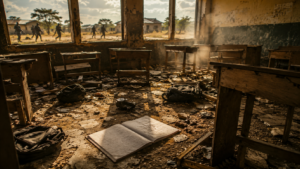
Across parts of Nigeria, classrooms are no longer just centres of learning. They are becoming potential crime scenes. School compounds are turning into hunting grounds for kidnappers. Teachers are increasingly becoming targets. Students are becoming bargaining chips.
And under President Bola Ahmed Tinubu’s administration, the crisis appears to be growing faster than solutions.
The latest example comes from Oyo State, where public school teachers have declared an indefinite strike after the abduction of teachers and pupils in Oriire Local Government Area. The strike, beginning June 1, 2026, effectively shuts down public education across the state as fear overwhelms the school system.
But Oyo is not an isolated incident.
It is part of a disturbing national pattern.
The Classroom Has Become A Battlefield
For years, Nigerians believed mass school kidnappings were largely a northern problem.
That illusion has collapsed.
From Kaduna to Niger, from Katsina to Oyo, insecurity is steadily spreading into spaces that should be safest for children.
The frightening reality is that many teachers now walk into classrooms wondering if armed men could storm the premises before the final bell rings.
Parents are asking themselves a painful question:
Is education still worth the risk?
The Oyo Crisis That Triggered A School Shutdown
The abduction of teachers and pupils in Oriire Local Government Area did more than shock residents.
It broke something inside the education community.
Teachers watched colleagues disappear into captivity.
Students vanished.
Families were left in agony.
As fear spread across schools, the Nigeria Union of Teachers concluded that enough was enough.
The result was an indefinite strike that has now shut public schools across Oyo State.
The message from teachers was clear: If government cannot guarantee safety, learning cannot continue.
The Kuriga Nightmare That Exposed Nigeria’s Deepest Failure
Perhaps no incident under Tinubu’s administration symbolises the education-security crisis more than the horrifying mass abduction in Kuriga, Kaduna State.
In March 2024, armed men stormed a school during assembly and kidnapped more than 200 pupils and staff members. Some reports initially placed the figure close to 300.
The images shocked the world.
Children were marched into forests.
Parents broke down in tears.
Families spent days trapped between hope and despair.
For over two weeks, classrooms remained empty as fear consumed the community. The attack became one of the largest school kidnappings Nigeria had witnessed in years.
Even after the eventual rescue of many victims, one painful question remained unanswered:
How did hundreds of children disappear from a school in the first place?
Education Cannot Survive Where Fear Rules
Schools function on one invisible ingredient: Trust.
Parents trust that their children will be protected.
Teachers trust that their workplaces are secure.
Students trust that learning environments are safe.
When that trust disappears, education begins to collapse.
And that collapse may already be happening.
In many vulnerable communities, attendance has dropped after attacks.
Some parents now prefer keeping children at home rather than risking their lives.
Others are abandoning public schools entirely.
The long-term consequences could be devastating.
The Hidden Cost Nobody Is Talking About
When politicians discuss insecurity, they often focus on casualty figures.
But education experts warn that the deeper damage may be happening quietly.
Every school closure creates learning gaps.
Every kidnapping creates trauma.
Every attack pushes more children out of classrooms.
Some victims never return to school.
Some parents never trust the system again.
Some communities lose entire generations of educated young people.
What begins as a security crisis eventually becomes an economic crisis.
And then a national development crisis.
Teachers Are Becoming Casualties Too
The conversation often centres on students.
But teachers are also paying a heavy price.
Across several states, educators now work under conditions many describe as terrifying.
Some travel through dangerous routes daily.
Others teach in communities constantly threatened by armed groups.
The Oyo strike reflects a growing frustration among teachers who feel abandoned.
Many are asking:
Why should educators continue risking their lives when government appears unable to secure schools?
Tinubu’s Security Promises Under Growing Scrutiny
When President Bola Tinubu assumed office in May 2023, security was one of the key promises of his administration.
Three years later, many Nigerians believe the results remain difficult to see.
While security agencies continue to record operations against bandits, terrorists and kidnappers, attacks on schools continue to generate national outrage.
Critics argue that successful military operations mean little to parents whose children still disappear from classrooms.
They insist that security should not be measured by press statements.
It should be measured by whether children can safely attend school.
A Dangerous Future Is Emerging
Nigeria already has one of the world’s highest numbers of out-of-school children.
Now insecurity is threatening to make the crisis even worse.
Every attack pushes more families away from formal education.
Every school closure strengthens ignorance, poverty and desperation.
And history shows that societies that fail to protect education often pay a terrible price later.
The frightening possibility is that Nigeria may be raising a generation shaped more by fear than by learning.
Is Anybody Truly Safe Anymore?
The spread of attacks beyond traditional conflict zones has created a disturbing national reality.
The crisis is no longer confined to remote villages.
It is becoming a nationwide concern.
If teachers can be kidnapped.
If pupils can vanish from classrooms.
If schools can shut down indefinitely because of insecurity.
Then many Nigerians are beginning to ask a painful question: Has education become another casualty of Nigeria’s worsening security crisis?
The Verdict Nigerians Must Confront
The closure of schools in Oyo is not just an education story.
It is an indictment.
It is a warning.
And it is a reflection of a country where fear is increasingly determining who learns, who teaches and who stays home.
People Also Read: Fear In Schools As Oyo Teachers Declare Indefinite Strike Over Insecurity
Three years into Tinubu’s presidency, the question is no longer whether insecurity exists.
The question is how much longer Nigeria can afford to watch insecurity slowly suffocate education before the damage becomes irreversible.
Because when classrooms close, the future closes with them.