

In 1956, Stanley Matthews, gracing the pitch in his crisp Blackpool jersey, became the first man ever to win the Ballon d’Or. Simple, elegant, legendary.
Fast forward to 2024, and Rodri, a defensive midfielder for Manchester City, lifts the trophy, breaking centuries of narrative that prized flair over function. Those winners between Matthews and Rodri are more than just names and clubs; they are mirrors of eras, flickers of change, reflections of who we celebrated and why.
Indeed, every winner tells a story: how football evolved, where attack was once everything, where defense finally got its due; how Europe once excluded non Europeans (only later changed), and how media influence, club power, and global reach now matter just as much as pure skill.
For football lovers, the Ballon d’Or list isn’t just trivia. It’s about identity, about bias, about which styles got spotlight and which got overshadowed.
The Story So Far
However, in modern times, Lionel Messi and Cristiano Ronaldo turned the Ballon d’Or into a two-man rivalry that spanned more than a decade.
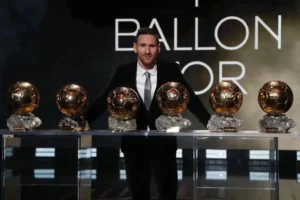
Also, Messi, with a record eight titles, remains the most decorated player in Ballon d’Or history. Cristiano Ronaldo follows with five.
Meanwhile, Luka Modrić, Karim Benzema, and most recently Manchester City’s Rodri, who lifted the 2024 prize after a treble-winning campaign, are among those who broke their dominance.
Also Read: Full List Of Female Lagos LG Officers Who Died In 2025
Recognising the growing power of women’s football, France Football introduced the Ballon d’Or Féminin in 2018.
Ada Hegerberg won the historic first edition, followed by U.S. star Megan Rapinoe in 2019. Spain’s Alexia Putellas went back-to-back in 2021 and 2022, before Aitana Bonmatí carried the torch in 2023 and 2024.
Below is the complete list of Ballon d’Or winners:
Men’s Ballon d’Or winners
1956 – Stanley Matthews (Blackpool / England)
1957 – Alfredo Di Stéfano (Real Madrid / Spain-Argentina)
1958 – Raymond Kopa (Real Madrid / France)
1959 – Alfredo Di Stéfano (Real Madrid / Spain-Argentina)
1960 – Luis Suárez (Barcelona / Spain)
1961 – Omar Sívori (Juventus / Italy-Argentina)
1962 – Josef Masopust (Dukla Prague / Czechoslovakia)
1963 – Lev Yashin (Dynamo Moscow / USSR)
1964 – Denis Law (Manchester United / Scotland)
1965 – Eusébio (Benfica / Portugal)
1966 – Bobby Charlton (Manchester United / England)
1967 – Florian Albert (Ferencváros / Hungary)
1968-1978
1968 – George Best (Manchester United / Northern Ireland)
1969 – Gianni Rivera (AC Milan / Italy)
1970 – Gerd Müller (Bayern Munich / West Germany)
1971 – Johan Cruyff (Ajax / Netherlands)
1972 – Franz Beckenbauer (Bayern Munich / West Germany)
1973 – Johan Cruyff (Barcelona / Netherlands)
1974 – Johan Cruyff (Barcelona / Netherlands)
1975 – Oleg Blokhin (Dynamo Kyiv / USSR)
1976 – Franz Beckenbauer (Bayern Munich / West Germany)
1977 – Allan Simonsen (Borussia Mönchengladbach / Denmark)
1978 – Kevin Keegan (Hamburg / England)
More Men
1979 – Kevin Keegan (Hamburg / England)
1980 – Karl-Heinz Rummenigge (Bayern Munich / West Germany)
1981 – Karl-Heinz Rummenigge (Bayern Munich / West Germany)
1982 – Paolo Rossi (Juventus / Italy)
1983 – Michel Platini (Juventus / France)
1984 – Michel Platini (Juventus / France)
1985 – Michel Platini (Juventus / France)
1986 – Igor Belanov (Dynamo Kyiv / USSR)
1987 – Ruud Gullit (AC Milan / Netherlands)
1988 – Marco van Basten (AC Milan / Netherlands)
1989 – Marco van Basten (AC Milan / Netherlands)
1990 – Lothar Matthäus (Inter Milan / West Germany)
1991 – Jean-Pierre Papin (Marseille / France)
1992 – Marco van Basten (AC Milan / Netherlands)
1993 – Roberto Baggio (Juventus / Italy)
1994 – Hristo Stoichkov (Barcelona / Bulgaria)
1995 – George Weah (AC Milan / Liberia)
1996 – Matthias Sammer (Borussia Dortmund / Germany)
1997 – Ronaldo Nazário (Inter Milan / Brazil)
1998 – Zinedine Zidane (Juventus / France)
1999 – Rivaldo (Barcelona / Brazil)
2000 – Luís Figo (Real Madrid / Portugal)
The New Age
2001 – Michael Owen (Liverpool / England)
2002 – Ronaldo Nazário (Real Madrid / Brazil)
2003 – Pavel Nedvěd (Juventus / Czech Republic)
2004 – Andriy Shevchenko (AC Milan / Ukraine)
2005 – Ronaldinho (Barcelona / Brazil)
2006 – Fabio Cannavaro (Real Madrid / Italy)
2007 – Kaká (AC Milan / Brazil)
2008 – Cristiano Ronaldo (Manchester United / Portugal)
2009 – Lionel Messi (Barcelona / Argentina)
2010 – Lionel Messi (Barcelona / Argentina)
2011-2024
2011 – Lionel Messi (Barcelona / Argentina)
2012 – Lionel Messi (Barcelona / Argentina)
2013 – Cristiano Ronaldo (Real Madrid / Portugal)
2014 – Cristiano Ronaldo (Real Madrid / Portugal)
2015 – Lionel Messi (Barcelona / Argentina)
2016 – Cristiano Ronaldo (Real Madrid / Portugal)
2017 – Cristiano Ronaldo (Real Madrid / Portugal)
2018 – Luka Modrić (Real Madrid / Croatia)
2019 – Lionel Messi (Barcelona / Argentina)
2020 – Not awarded (COVID-19)
2021 – Lionel Messi (Paris Saint-Germain / Argentina)
2022 – Karim Benzema (Real Madrid / France)
2023 – Lionel Messi (Inter Miami / Argentina)
2024 – Rodri (Manchester City / Spain)
Women’s Ballon d’Or (Ballon d’Or Féminin) winners
2018 – Ada Hegerberg (Lyon / Norway)
2019 – Megan Rapinoe (Reign FC / USA)
2020 – Not awarded (COVID-19)
2021 – Alexia Putellas (Barcelona / Spain)
2022 – Alexia Putellas (Barcelona / Spain)
2023 – Aitana Bonmatí (Barcelona / Spain)
2024 – Aitana Bonmatí (Barcelona / Spain)