

The tariff plan followed a legal setback.
First, the Supreme Court of the United States ruled that Donald Trump exceeded his authority to impose global tariffs.
Next, the administration introduced a replacement 10% tariff on all imports entering the United States.
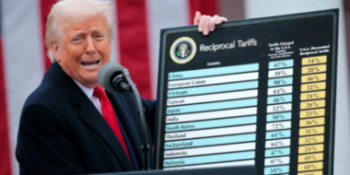
Court Ruling Shifts Strategy
Then, Trump changed course again.
On Truth Social, he raised the tariff to 15%.
After that, he used a rarely applied trade rule that allows temporary tariffs without immediate congressional approval.
Rapid Tariff Escalation
Meanwhile, the dispute centred on the International Emergency Economic Powers Act, which Trump previously used to impose sweeping tariffs.
Soon after, the court said Trump went beyond powers granted under that law in a 6–3 decision.
At the same time, official data shows the United States collected at least $130 billion in tariffs under IEEPA.
In response, Trump criticised the ruling and defended tariffs as central to economic and national security strategy.
Shortly after, the administration announced a 10% tariff and increased it to 15% within a day.
Read Also: Nigerians Drive Q4 2025 Spike In Grenada Citizenship
Following this shift, Trump relied on the Trade Act of 1974 Section 122, which allows tariffs lasting up to 150 days.
However, lawmakers from both parties criticised parts of the policy and challenged longer-term extension.
Global Impact Grows
Meanwhile, markets watched the timeline closely as officials planned the policy rollout.
Globally, trading partners assessed costs, risks, and possible retaliatory measures.
Specifically, the revised framework placed a 14% tariff on Nigerian exports to the United States.
According to the National Bureau of Statistics Nigeria, trade between both countries reached ₦31.1 trillion between 2015 and 2024.
During that period, Nigeria imported ₦16.4 trillion, representing 8.7% of its global exports.
Looking ahead, Trump will address lawmakers during the State of the Union speech in Washington.
There, he will highlight trade policy alongside inflation and cost-of-living concerns.
Ultimately, Trump continues the tariff strategy despite legal limits and signals further political and economic uncertainty.