
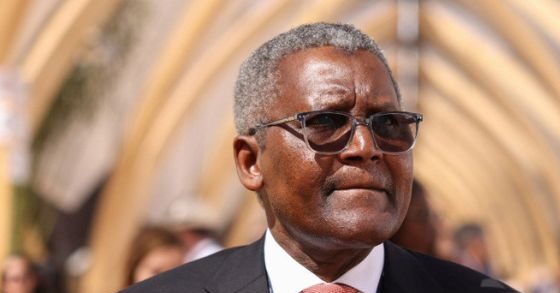
Aliko Dangote has pushed his wealth up to $36.7 billion, according to Bloomberg data.
This rise reinforces his position as Africa’s richest man and leading Black billionaire globally.
His expansion across energy, cement, and agriculture drives this surge.
Industrial Expansion And Refinery Growth
He builds his empire around cement, sugar, and fertiliser operations.
However, he places the $20 billion Lagos refinery at the centre of growth.
The refinery transforms Nigeria’s energy profile and boosts industrial output at scale.
As a result, Nigeria now exports petroleum for the first time in decades, averaging 44,000 barrels daily.
The refinery supplies West African markets, including Ghana, Togo, and Cameroon.
Consequently, this shift strengthens hard-currency earnings and reduces reliance on local currency inflows.
Dangote Industries signs a $400 million contract to expand refinery capacity.
The group targets full production increases by 2029 through major upgrades.
In addition, it advances a wider $11.5 billion programme for chemical production expansion.
Read Also: NISO Warns Citizens Over Misleading Grid X Account
Aliko Dangote’s Refinery Export And Chemical Diversification
The group also plans to produce linear alkyl benzene for detergent manufacturing.
Meanwhile, it prepares an IPO to unlock significant public market value.
Dangote Cement continues to anchor group earnings.
It records over ₦1 trillion profit in one year and drives a 162% share price gain.
As a result, its valuation reaches about ₦20.1 trillion.
Continental Expansion And Global Positioning
Furthermore, the company expands across Africa with a planned refinery in Tanga, Tanzania.
The group targets 2.1 million barrels per day refining capacity globally.
Simultaneously, it builds a $2.6 billion fertiliser plant in Ethiopia’s Somali region, producing three million tonnes annually.
It also secures a $4.3 billion gas deal with GCL Group to stabilise supply.
Finally, a Dubai family office manages global assets and reduces currency risk exposure.
Overall, analysts frame Dangote’s rise as large-scale African industrial transformation.