
In 1977, the Nigerian state deployed 1,000 soldiers to siege a single residential compound. They did not come for a drug cartel. They came to silence Fela Kuti, a man whose saxophone had become a weapon against military corruption.
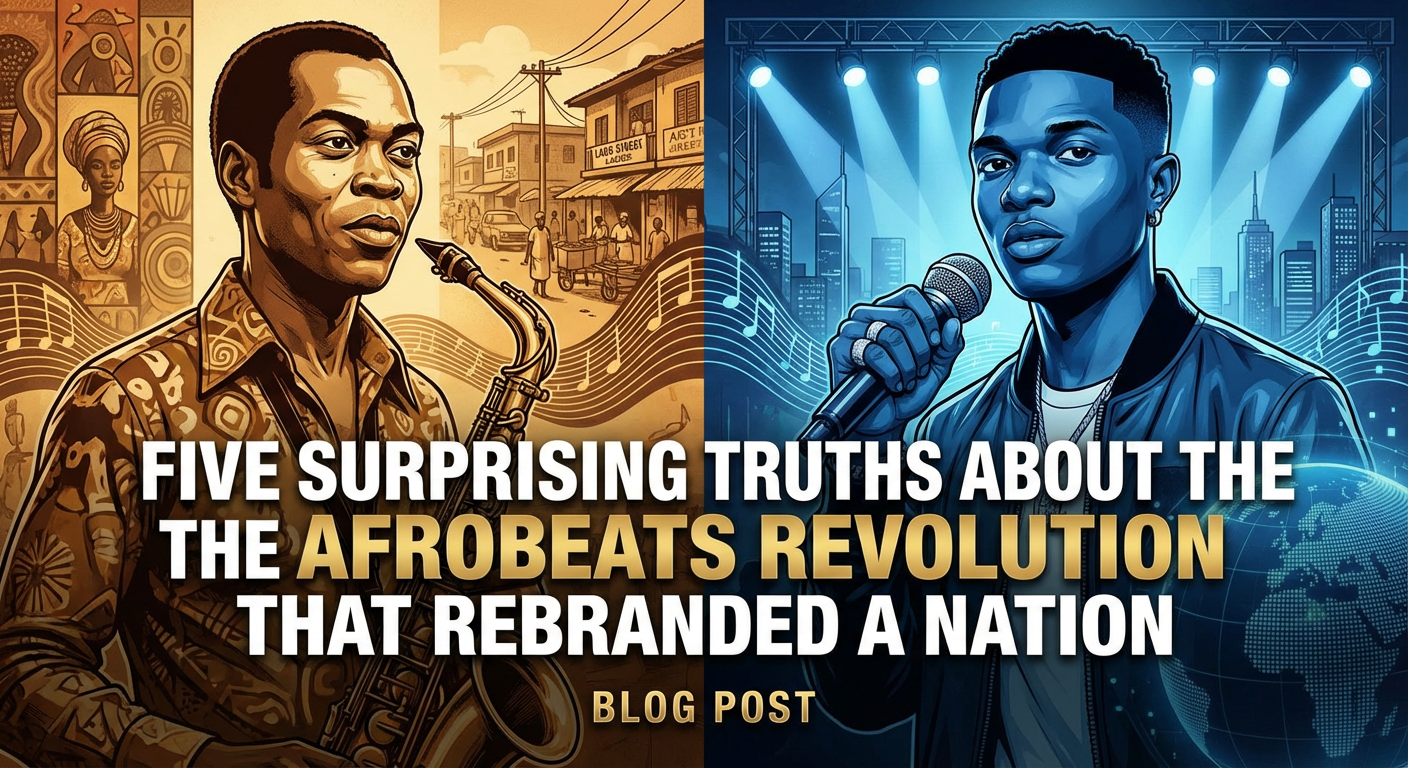
Fast forward to 2026, and the image of Nigeria has undergone a radical transformation.
Instead of the smoke of a burning commune, the world now watches the glow of 20,000 smartphones at a sold out Wizkid concert in London.
So why has a single letter become such a flashpoint for an entire generation?
The shift from Afrobeat to Afrobeats might seem like a minor spelling change, but it represents something much deeper.
It marks a collision between two fundamentally different ideas about what music should do for a nation.
In the wake of the “Big pass your papa” social media firestorm earlier this year, one thing became clear. This was never really about celebrity beef. It was always about identity, legacy, and the soul of Nigerian music itself.
Let me walk you through what this cultural moment actually reveals.
The Globalism Tax And The Price of Going Worldwide
Here is something that does not get discussed enough.
The journey from Fela’s Afrobeat to modern Afrobeats represents a fundamental shift from resistance to resonance.
Think about it this way. Fela’s compositions were hypnotic trials. We are talking about 20 minute polyrhythmic journeys featuring complex live instrumentation.
Bass guitar, African percussions, electric piano, all working together to hold listeners in a state of rhythmic hypnosis until they were forced to confront uncomfortable truths about corruption and inequality.
Modern Afrobeats operates on completely different principles.
The formula now runs about three minutes. The instrumentation has shifted from organic to electronic, heavily influenced by EDM to ensure the music travels seamlessly across digital platforms and streaming services.
To achieve global market penetration, the music had to undergo what I call a systematic softening of the edges.
Biting Pidgin English gave way to melodic hooks. Political urgency was traded for party vibes and luxury aesthetics.
Now here is the honest question we need to ask ourselves. Is accessibility just another word for dilution?
This is the globalism tax in action. To reach everyone, you have to stand for less. Nigeria has absolutely secured its seat at the high table of global pop.
But the price of admission was the abandonment of radical truth telling. We gained the world’s ear, but we may have lost our voice in the process.
Unofficial Ambassadors And The Power Of Cultural Diplomacy
For decades, Nigeria was shackled to a single story. Corruption. Fraud. Scams. Remember when former British Prime Minister David Cameron casually described Nigeria as “fantastically corrupt” back in 2016? That was the narrative we could not seem to escape.
Where government led initiatives failed to shift this perception, Afrobeats artists succeeded in ways nobody predicted.
They became unofficial ambassadors, wielding soft power more effectively than any diplomatic mission ever could.
By projecting flamboyant wealth and using cultural signifiers, these artists provided a version of Nigeria that global audiences found aspirational rather than threatening.
Think about Wizkid incorporating Yoruba tribal marks in his visuals. Or Burna Boy wearing Ankara at the UEFA Champions League final.
These moments transformed the national image from one of lack to one of abundant cultural wealth.
The music created remarkable shifts in boosting national perception and the self esteem of Nigerians around the globe. Through Afrobeats, Nigeria regained alliances, treaties, and partnerships with other nations.
But there is a profound irony here that we cannot ignore.
While Afrobeats acts as a shield for the Nigerian identity abroad, it often masks darker realities at home.
Even as our music conquers international charts, the Lakurawa armed group in Northern Nigeria has officially banned listening to music in territories they control.
The music provides an escape route from a harsh economic landscape, but we have to wonder whether this flamboyant projection is actually a false front that ignores persistent security challenges.
The Bigger Than Fela Paradox and What Greatness Really Means
The 2026 debate surrounding those controversial social media posts highlighted something important. We have a fundamental misunderstanding of what greatness actually means.
By commercial metrics alone, the modern era is mathematically bigger. Ten billion streams. Grammy wins. Global brand partnerships. If you measure purely by numbers, there is no contest.
But here is what that calculation misses entirely.
Fela Kuti operated in the category of musician and prophet. Wizkid occupies the role of celebrity and pop star.
These are not the same job descriptions, and comparing them is like comparing architects to interior designers.
Both valid, but fundamentally different enterprises.
Consider the contrast. Fela was a classically trained composer who invented an entirely new musical language.
He paid for his truth with prison, beatings, and the destruction of his home. Even now in 2026, his legacy continues to grow.
Zombie has been inducted into the Grammy Hall of Fame, and Fela has received a posthumous Lifetime Achievement Award, making him the first African artist ever to receive this honor from the Recording Academy.
Wizkid himself seems to understand this complexity. He carries Fela’s face as a tattoo on his arm. In an interview with Pulse TV, he put it plainly.
“No you cannot compare. Let us not use that word. That is like disrespect when you are mentioning Wizkid and Fela in the same sentence. That is someone that inspires me.”
There is wisdom in that statement. The modern generation sometimes feels a desperate need to diminish the past to validate its own unprecedented commercial success. But charts are temporary.
Vibes are fleeting. Fela’s greatness is measured by sacrifice. Wizkid’s is measured by reach. Both are achievements, but they exist on entirely different scales.
As Femi Kuti, Fela’s son, noted, “Fela is the musical and artistic template in Nigeria. So Fela should just be put in a sector of his own and we just idolize and respect him.”
From Resistance to Aspiration and the Rise of the Star Boy Dream
Perhaps the most significant shift in the genre is the change in its economic engine.
The music has moved from the community hub of the Shrine to a borderless digital economy.
And this reflects a corresponding shift in what we might call the Nigerian Dream.
Think about the class dynamics at play here. Fela came from an educated, upper class background. His mother was a prominent activist. He had every advantage.
Yet, he consciously chose what he called the gutter, positioning himself alongside the poor and dispossessed.
Wizkid represents the opposite trajectory. The Ojuelegba narrative. The poor boy escaping the slum to own the private jet. From nothing to everything through talent and hustle.
This Star Boy narrative resonates more with modern youth than Fela’s suffering and smiling message. And the reason is actually quite simple.
It offers an idol to worship rather than a sacrifice to emulate. The artist has transitioned from being a communal mouthpiece to a global corporation.
There is something fascinating and somewhat troubling about this reversal. Fela gave the nation the truth. A vision that was often raw, painful, and ugly. Wizkid gives the nation a dream.
Wealthy, powerful, untouchable.
As these artists become corporate entities, they provide the template for modern African aspiration. They show us who we want to be, even if they no longer remind us of who we actually are.
A Continent at the Crossroads
So where does this leave us?
Afrobeats has undeniably rebranded Nigeria. It has attracted foreign investment and replaced a narrative of poverty with one of power.
When the beat drops in clubs from Lagos to London to Los Angeles, Nigeria is no longer the cautionary tale. It is the main character.
You May Like: Grammy Awards: How Davido Is Slowly Becoming the ‘Atiku’ of Nigeria’s Entertainment Industry
Yet as the world dances to these frictionless rhythms, the original problems have not disappeared. Corruption persists. Insecurity remains.
The suffering and smiling that Fela documented continues behind the autotune and the filter.
The genre has achieved global fortune. But Fela was seeking freedom. These are not the same destination.
Perhaps there is something poetic about the timing of all this. At the 2026 Grammys, Fela Kuti received a posthumous Lifetime Achievement Award, becoming the first African artist in history to receive this honor from the Recording Academy.
Nearly three decades after his death, the world finally caught up to what he was saying all along. The man they tried to silence with soldiers now stands immortalised at the highest level of global music recognition.
As we move further into this Star Boy era, one question keeps nagging at me. It comes from the very heart of our musical history, and I do not think we have answered it yet.
When the world is done dancing to our rhythm, will they remember anything we said?