

Running a small business often feels like having ten different jobs and receiving one salary, if you are lucky.
A business owner may begin the morning responding to customer messages, spend the afternoon creating promotional content, use the evening calculating expenses and still have outstanding orders to attend to before going to bed.
For many entrepreneurs, the challenge is not a shortage of ideas or willingness to work. It is finding enough time, money and people to handle everything required to keep the business moving.
Consider a small fashion business in Lagos. Its owner is responsible for sourcing clothes, negotiating with suppliers, taking product photographs, posting on Instagram, responding to WhatsApp enquiries, processing orders and keeping financial records.
The business may be making sales, but the owner is spending so much time handling routine activities that there is hardly any opportunity to focus on expansion.
This is where artificial intelligence can make a difference.
AI tools can help small businesses complete certain tasks faster, organise information, generate ideas, analyse data and automate repetitive activities. Some are available for free, while others offer paid subscriptions depending on the features required.
The exciting part is that businesses do not necessarily need a large technology budget to begin benefiting from them.
Whether you operate a small shop, food business, fashion brand, digital agency, logistics company or service-based business, here are 10 practical ways to use AI to save time and money.
1. Use AI to Create Social Media Content Without Hiring an Entire Marketing Team
For small businesses trying to attract customers online, creating content consistently can become a full-time responsibility.
There are captions to write, promotional messages to prepare, product descriptions to develop, videos to script and content ideas to generate.
Unfortunately, not every small business can afford a dedicated social media manager, copywriter, graphic designer and marketing strategist.
AI tools such as ChatGPT can help reduce that pressure.
A business owner can use AI to generate content ideas, draft Instagram captions, write Facebook advertisements, develop TikTok video scripts and create promotional messages for WhatsApp.
For example, a small bakery preparing for Christmas sales can ask an AI assistant to generate a week-long content calendar featuring product promotions, behind-the-scenes videos, customer testimonials and festive offers.
Instead of spending hours thinking about what to post every morning, the owner can prepare several content ideas in one sitting and edit them to reflect the business’s personality.
AI can also help businesses adapt one piece of content for different platforms.
A product announcement originally written for Instagram can be transformed into a shorter WhatsApp message, a Facebook post or a script for a TikTok video.
This can reduce the time spent creating content while helping businesses maintain a more consistent online presence.
The money-saving advantage: Businesses can reduce the amount of time spent on routine content production and may not need to outsource every small writing task.
However, AI-generated content should always be reviewed. Your customers are dealing with your business, not a chatbot, so your communication should still sound human.
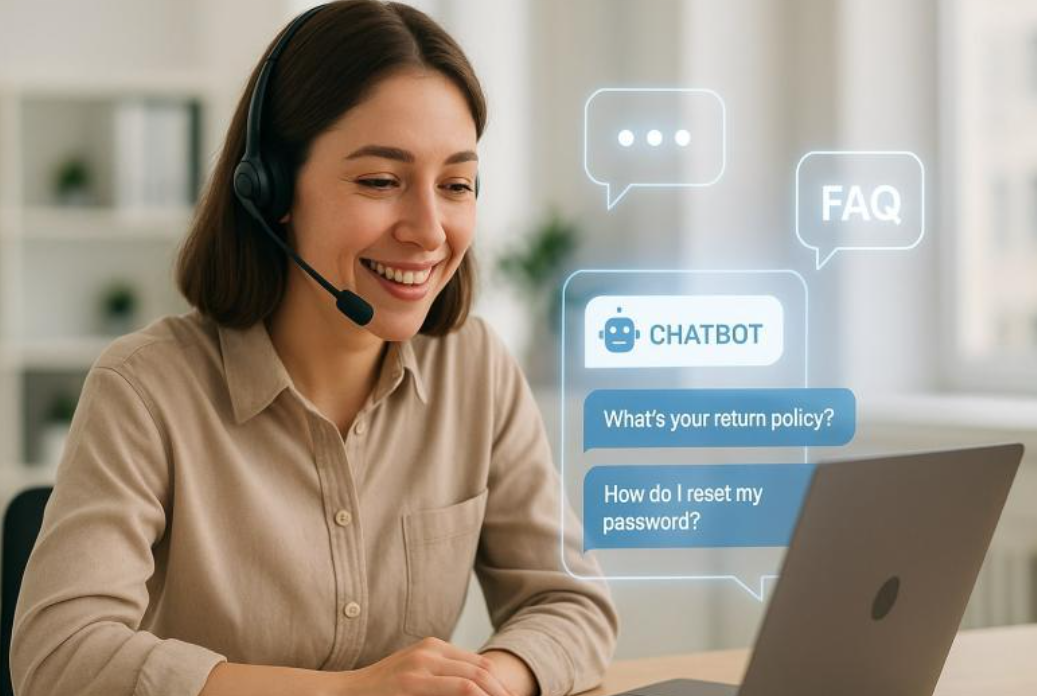
2. Automate Customer Enquiries and Frequently Asked Questions
Imagine running a restaurant and receiving the same questions every day.
What is on the menu? How much is delivery? Where are you located? Do you accept transfers? What time do you close?
For an online fashion store, the questions may be different but equally repetitive.
Customers want to know available sizes, colours, prices, delivery fees and whether an item is still in stock.
Responding to every enquiry individually can consume valuable working hours, particularly when several customers are messaging at the same time.
AI-powered customer service tools and automated messaging systems can help businesses handle some of these interactions.
Depending on the platform, businesses can configure automated responses, answer common questions, guide customers through product options and direct more complicated enquiries to a human representative.
For instance, a small restaurant can set up a messaging system that provides its menu, opening hours, location and ordering instructions when customers make enquiries.
Some AI-enabled systems can also interpret more conversational questions rather than relying entirely on customers selecting predefined options.
The important thing is to know when automation is appropriate.
A customer asking for your opening hours may not need a human representative. Someone complaining about a missing order or requesting a refund probably does.
The money-saving advantage: Automation can reduce the time spent answering repetitive enquiries, allowing employees to concentrate on orders, complaints and other activities that require human attention.
3. Use AI to Write Product Descriptions and Promotional Messages
Selling a product is one thing. Explaining why customers should buy it is another.
A small business selling skincare products, furniture, electronics, food or clothing needs descriptions that communicate what it offers and why customers should be interested.
Unfortunately, writing attractive descriptions for dozens or hundreds of products can be exhausting.
AI can simplify this process.
A retailer can provide the basic information about a product and ask an AI tool to produce a clear, engaging description suitable for an online store, social media page or sales catalogue.
For example, a business selling locally made leather bags can provide information about the material, dimensions, available colours, design and intended use.
The AI tool can turn those details into a structured product description that highlights the bag’s practical features and appeals to the intended audience.
The same approach works for promotional campaigns, email announcements, product launches and seasonal offers.
AI can even help produce different versions of an advertisement for different customer groups.
However, there is one important rule: never allow AI to invent product features, certifications, discounts or benefits that your business cannot substantiate.
The money-saving advantage: Faster product description writing can reduce content production costs and help businesses list new products more efficiently.
4. Let AI Help You Understand Your Sales and Business Records
Many small businesses make sales without properly understanding what their numbers are saying.
An entrepreneur may know that ₦500,000 entered the business account last month but may not know which products generated the most profit, which expenses increased or why the business has less money available than expected.
This is where AI-assisted data analysis can become useful.
Businesses can use tools such as ChatGPT, Microsoft Copilot or spreadsheet-based AI features to examine properly organised sales and expense records.
For instance, a supermarket owner can organise monthly sales by product category and use an AI assistant to identify which categories recorded the highest sales, which products moved slowly and where expenses increased.
A fashion retailer may discover that certain products generate impressive revenue but contribute very little profit after sourcing, transportation, packaging and advertising costs.
AI can also help explain spreadsheet formulas, summarise reports and identify patterns that may deserve further investigation.
However, AI should not replace proper bookkeeping or financial judgment. Its analysis is only as reliable as the information supplied, and important financial calculations should be checked.
Businesses should also avoid uploading confidential customer details, bank information or sensitive financial records to AI platforms without understanding their privacy and data-handling arrangements.
The money-saving advantage: Better analysis can help business owners identify unnecessary expenses, make more informed purchasing decisions and understand where their money is going.
5. Use AI to Manage Inventory and Reduce Waste
Few things are more frustrating for a business owner than discovering that a popular product has sold out while another product has remained untouched on the shelf for months.
Poor inventory management can tie down money, create unnecessary losses and leave businesses unable to satisfy customers.
For businesses dealing with food, fashion, cosmetics, electronics and other physical products, knowing what to stock and when to restock is extremely important.
AI-assisted inventory systems can help businesses analyse sales history, identify purchasing patterns and estimate future demand.
For example, a small grocery store can use its previous sales records to identify products that sell faster during weekends, festive periods or particular seasons.
A restaurant can analyse ingredient usage to improve purchasing decisions and reduce food waste.
A fashion retailer can examine which clothing categories and sizes attract the most customers before placing another order with suppliers.
Some inventory platforms also provide automated alerts when stock levels become low.
However, businesses should understand that demand forecasts are estimates, not guarantees. Unexpected economic changes, supplier disruptions, price increases and customer preferences can affect actual demand.
The money-saving advantage: Better stock management can reduce waste, prevent unnecessary purchases and help businesses avoid tying up too much money in slow-moving products.
6. Use AI to Improve Advertising and Marketing Campaigns
Spending money on advertising without understanding whether it is attracting the right customers can quickly become an expensive mistake.
A small business may spend ₦50,000 promoting products on social media, receive hundreds of views and likes, but generate very few actual purchases.
The problem may be the advertisement, the audience, the product presentation or the offer itself.
AI can help businesses improve different stages of their marketing campaigns.
It can generate advertising ideas, suggest alternative headlines, develop promotional messages, create audience profiles from properly collected information and help compare different versions of marketing copy.
Some advertising platforms also provide AI-powered features that assist with creative production, audience targeting and campaign optimisation.
For instance, a small business selling household appliances can test two different advertising messages: one focusing on affordability and another highlighting product durability.
By examining actual campaign results, the business can identify which message attracts more qualified enquiries and sales.
AI can also help businesses study customer feedback and identify recurring complaints, preferences and purchasing motivations.
However, marketing decisions should be based on real performance data rather than assumptions generated by a chatbot.
The money-saving advantage: Better marketing preparation and analysis can help businesses reduce wasted advertising expenditure and improve their chances of reaching interested customers.
7. Generate Professional Business Designs and Visual Content
A business does not necessarily need to employ a full-time graphic designer to produce every basic promotional design.
AI-powered design tools can help entrepreneurs create social media graphics, presentation layouts, promotional materials, product mock-ups and other visual content.
Platforms such as Canva offer AI-assisted design features that can speed up creative work.
For example, a small restaurant preparing a weekend food promotion can use a design platform to create a promotional layout, add its food photographs, include prices and prepare versions suitable for different social media platforms.
A fashion brand can experiment with different promotional concepts, while a small consultancy can prepare professional-looking presentation materials.
Some AI image-generation tools can also help businesses develop original visual concepts for campaigns.
However, businesses should be careful when using generated images to advertise real products. An image should not misrepresent the actual appearance, quality or features of something being sold.
They should also check the licensing and usage conditions of any design assets they use commercially.
The money-saving advantage: AI-assisted design can reduce the time and cost involved in producing routine marketing materials, particularly for businesses with limited creative budgets.
8. Use AI to Prepare Emails, Proposals, Invoices and Other Business Documents
Administrative work can quietly consume a significant portion of a small business owner’s day.
There are supplier emails to write, customer follow-ups to send, business proposals to prepare, meeting notes to organise and formal messages to draft.
AI tools can help businesses prepare many of these documents faster.
For example, a small logistics company can use an AI assistant to draft a professional response to a corporate customer requesting transportation services.
A freelance consultant can use AI to structure a project proposal, while a retailer can prepare supplier enquiries and customer follow-up messages.
AI can also help organise rough notes into clearer business reports and turn meeting discussions into action points.
For businesses that regularly communicate with customers and suppliers, these capabilities can reduce the time spent starting every document from an empty page.
Nevertheless, important documents should always be checked before they are sent. AI can misunderstand instructions, introduce inaccurate information or use language that does not reflect the business’s actual agreement.
It should also not be trusted to invent payment terms, contractual obligations or legal conditions.
The money-saving advantage: Faster document preparation reduces administrative pressure and gives business owners more time for activities that directly contribute to revenue.
9. Use AI to Support Staff Training and Everyday Problem-Solving
Small businesses sometimes struggle to provide formal training for employees because professional training programmes can be expensive and time-consuming.
Yet, employees still need to understand how to communicate with customers, handle complaints, operate business systems and follow company procedures.
AI can help create basic training materials and learning resources.
A restaurant owner, for example, can use an AI assistant to prepare a customer service guide explaining how staff should welcome customers, handle complaints and respond to common questions.
A retail business can develop a simple product knowledge guide for new employees.
AI can also explain unfamiliar concepts, generate practice questions and create realistic customer-service scenarios for staff training.
Employees can use approved AI tools to learn how to perform certain tasks, understand spreadsheet formulas or improve their writing and communication.
However, businesses should establish clear rules about what employees can and cannot share with AI platforms.
Confidential company information, customer records and sensitive commercial documents should be protected.
The money-saving advantage: AI-assisted learning can make basic training more accessible and reduce the time managers spend repeatedly explaining routine procedures.
10. Automate Repetitive Tasks and Give Yourself More Time to Grow the Business
Perhaps the biggest opportunity AI offers small businesses is the ability to reduce the amount of time spent on repetitive activities.
Consider a small online store that receives orders through its website, communicates with customers on WhatsApp and records purchases in a spreadsheet.
Without an organised system, the owner may have to manually transfer customer details, update order records, send confirmations and notify staff whenever a purchase is made.
Automation tools can connect certain business applications so that an action in one system triggers another.
For example, an online order may automatically generate an internal notification, update an inventory record or trigger a customer confirmation message.
Platforms such as Zapier and Make allow businesses to build workflows connecting compatible applications, while some customer relationship management and e-commerce systems provide their own automation features.
The possibilities depend on the applications being used, their available integrations and the subscription plan.
A business should start with one repetitive process that consumes considerable time, test the automation and confirm that it works correctly before expanding it.
Automation should also include appropriate human checks, particularly where money, customer complaints, payments or important business decisions are involved.
The money-saving advantage: Reducing repetitive manual work can improve efficiency, lower administrative pressure and allow business owners to concentrate on sales, customer relationships and business development.
AI Tools Small Businesses Can Start Exploring
You do not need to subscribe to every AI platform available. The best approach is to identify the task you want to improve and select a tool that can handle it.
Here are some popular options worth exploring:
| AI tool | What it can help with |
|---|---|
| ChatGPT | Content writing, research assistance, brainstorming and data analysis |
| Google Gemini | Writing assistance, research and productivity tasks |
| Microsoft Copilot | Productivity, document assistance and spreadsheet-related tasks |
| Canva AI | Graphic design and marketing content |
| Grammarly | Writing improvement and communication |
| Zapier | Connecting applications and automating workflows |
| Make | Building automated business processes |
| HubSpot | Customer relationship management and sales workflows |
Features, integrations, usage limits and pricing vary across platforms and may change. Businesses should check current plans before committing to paid subscriptions.
How Small Businesses Can Start Using AI Without Spending Too Much
Knowing what AI can do is one thing. Introducing it into an actual business is another.
For small businesses operating with limited resources, the smartest approach is to begin with practical problems rather than purchasing several subscriptions immediately.
Here are a few sensible steps:
Identify your biggest time-consuming task: Is it answering customer enquiries, preparing content, managing inventory or organising records? Start with the problem that takes the most time or creates the most avoidable expense.
Choose one suitable tool: Research the available options and begin with a free plan or trial where appropriate. Avoid paying for features your business does not need.
Test it on a small scale: Use AI for a specific task over a short period. Compare how long the task previously took with how long it takes using the new system.
Check the quality of the results: Faster work is not necessarily better work. Review AI-generated messages, reports, designs and recommendations before using them.
Train employees properly: If staff members will use AI, explain what the tools are for, what information must remain confidential and which tasks require human approval.
Measure the savings: Track the time saved, money spent on subscriptions, reduction in errors and any improvement in customer service or business performance.
The objective is not to introduce AI into every corner of the business. It is to make the business more efficient without creating unnecessary complexity.
Important Mistakes Small Businesses Should Avoid When Using AI
AI can be useful, but treating it as a replacement for human judgment can create new problems.
Business owners should avoid relying on unverified AI-generated information, especially when making financial, legal, tax or regulatory decisions.
They should also protect customer information, employee records, passwords, payment details and confidential business documents.
Another common mistake is paying for several subscriptions without understanding whether the tools actually solve a business problem.
Don’t Miss: How to Find Legitimate Remote Jobs Without Falling for Scams
There is also the temptation to automate every customer interaction. While automated systems can handle routine enquiries, customers still need access to real people when dealing with complicated complaints, sensitive issues or important transactions.
Most importantly, AI should support the people running a business, not remove accountability from them.
Final Thoughts: Small Businesses Do Not Have to Work Harder at Everything
For many entrepreneurs, business growth has traditionally meant working longer hours, hiring more employees and taking on additional expenses.
But technology is gradually changing that equation.
A small business owner who once spent several hours preparing promotional content can now use AI to generate a first draft in minutes. A retailer struggling with sales records can use AI-assisted analysis to understand purchasing patterns. A service provider can automate repetitive administrative tasks and devote more time to customers.
None of these tools guarantees higher profits or eliminates the challenges of running a business. Their value depends on how intelligently they are selected, implemented and monitored.
The real opportunity is that small businesses can now access capabilities that were once difficult or expensive to obtain.
And in a competitive business environment where time, money and efficiency matter, knowing how to use those capabilities could become a significant advantage.
You do not need to build a technology company to benefit from artificial intelligence.
Sometimes, all you need is one repetitive task, one useful AI tool and the willingness to discover a smarter way of getting things done.