

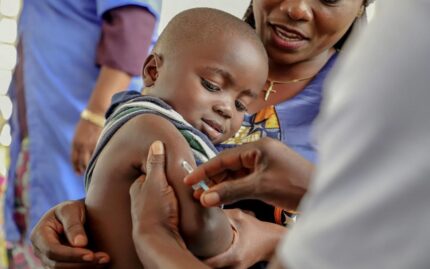
In Lagos, health officials are driving a steady public health effort to improve child immunisation across communities.
The Lagos State Primary Health Care Board allocates 5% of the health budget to immunisation.
Budget Support For Immunisation
Permanent Secretary Ibrahim Mustafa disclosed this during World Immunisation Week.
This investment has helped Lagos achieve 66% routine immunisation coverage across the state.
Mustafa explained that the state combines federal vaccine supply with its own logistics funding.
The government strengthens cold chain systems and supports frontline health workers.
Partners such as WHO, UNICEF, Gavi, AFENET, and Nigeria’s primary health agency also support the programme.
However, challenges persist across the rapidly growing city.
Zero-Dose Children And Access Gaps
Lagos records 120,000 to 130,000 zero-dose children who have never received routine vaccines.
Many families live in Makoko, Alimosho, and Ikorodu.
In addition, migration increases these gaps significantly.
Families arrive in Lagos with children who missed vaccinations in other regions.
Nevertheless, Mustafa noted that Lagos still outperforms many states due to stronger health systems.
HPV Rollout And Rising Acceptance
The state recently scaled up the HPV vaccine rollout for girls aged nine to 14.
Read Also: Rising US Wheat Prices Signal Higher Bread Prices For Nigeria
Officials introduced the programme two years ago across communities.
Initially, misinformation and distrust triggered strong resistance in several areas.
In some cases, vaccinators faced hostility in Ibeju-Lekki, so authorities deployed security escorts.
Meanwhile, the government expanded community engagement campaigns to address concerns.
Religious leaders, media organisations, and influencers promoted accurate information.
As a result, public trust improved gradually over time.
So far, more than 1.5 million girls have received the HPV vaccine.
Demand continues to rise as parents now actively request vaccination services.
At the national level, Nigeria still reports the highest number of zero-dose children globally.
Authorities recorded about 2.1 million cases in 2023, mostly in northern states.
A zero-dose child has not received any routine vaccination.
Consequently, these children face higher risks of preventable diseases and outbreaks.
World Immunisation Week runs annually from April 24 to 30.
This year’s theme states, “For every generation, vaccines work.”
The World Health Organization reports that vaccines have saved over 150 million lives globally.
Therefore, immunisation remains one of the strongest public health interventions.
Finally, Lagos continues to push forward toward universal child protection across all communities.
