

U.S. President Donald Trump has sharply criticised CNN over its reporting on a ceasefire agreement between Washington and Tehran, accusing the network of amplifying what he called a fabricated Iranian statement.
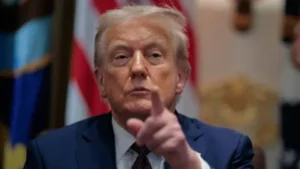
The dispute centers on coverage of a reported message attributed to Iran’s Supreme National Security Council (SNSC).
CNN had described the statement as portraying the ceasefire as a decisive victory for Iran, quoting language that framed the outcome as a “historic and crushing defeat” for its adversaries.
Trump, however, rejected the report outright in a post on Truth Social, calling it fraudulent.
Fake News From Nigeria
He further claimed—without offering evidence—that the statement originated from what he described as a “fake news” website based in Nigeria, and alleged that CNN picked it up and presented it as legitimate.

Although he did not identify the outlet in question, Trump characterized it as a “trouble-making” platform and urged CNN to retract the story.
He also hinted at possible investigations, suggesting authorities would assess whether any laws were broken in the publication of the report.
In contrast, Trump shared what he said was the authentic Iranian position, attributed to Foreign Minister Abbas Araghchi.
According to that version, Iran signaled a willingness to halt its defensive military actions if attacks from the United States and Israel ceased.
Araghchi also indicated that Iran would temporarily allow the reopening of the Strait of Hormuz, a critical global shipping route, under coordinated conditions with its armed forces and subject to logistical constraints.
Regulatory Consequences
Meanwhile, Iranian state-aligned media—including outlets linked to the Islamic Revolutionary Guard Corps—published statements similar to the one cited by CNN, reiterating claims that Iran had forced the United States into accepting a 10-point ceasefire framework and framing the outcome as a national triumph.
Amid the controversy, Brendan Carr, head of the U.S. Federal Communications Commission, weighed in more broadly on media responsibility.
He warned that broadcasters could face regulatory consequences if they fail to meet professional standards or act in the public interest, including the potential risk of losing their licenses.
CNN has stood by its reporting, maintaining that the statement it cited came directly from Iranian officials and was corroborated by multiple state-linked media sources in Iran.
You May Like: 2027: ADC Faction Fixes National Convention, Appoints Interim Leaders Amid Party Crisis
The clash highlights ongoing tensions not only between Washington and Tehran but also between political leaders and major media organizations over the accuracy and sourcing of sensitive international developments.