
In Ibadan, a protest by members of the Hausa community has reopened one of Nigeria’s most uncomfortable national conversations: how far fear of insecurity is quietly reshaping how citizens perceive one another.
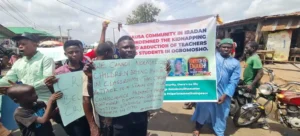
What began as outrage over kidnappings in Oyo State has now evolved into something deeper and more sensitive—allegations of ethnic profiling, suspicion, and growing mistrust among communities that have coexisted for decades.
And at the centre of it all is a difficult question: is Nigeria responding to insecurity with strategy—or with stereotypes?
A Protest Born Out of Fear of Stigma
On June 10, members of the Hausa community in Ibadan took to the streets, insisting they were being unfairly linked to recent kidnapping incidents in the state.
Their message was direct and emotional: criminals should be pursued as individuals, not as representatives of an entire ethnic group.
The protest followed a series of violent incidents in Oyo State, including the abduction of pupils and teachers in Oriire Local Government Area, attacks that triggered widespread panic and renewed fears about the safety of rural communities and schools.
But alongside the fear of crime, another tension began to surface—one not about the attackers themselves, but about who is being looked at with suspicion.
When Insecurity Begins to Redraw Social Boundaries
Across Nigeria, insecurity has become more than a security issue. It is now reshaping social psychology.
In communities hit by repeated kidnappings and banditry, residents often begin to search for patterns—faces, accents, settlements, or identities they associate, rightly or wrongly, with criminal activity.
This is where the danger begins.
Because in the absence of clear intelligence and accountability, fear can quickly turn into generalisation—and generalisation into profiling.
The Ibadan protest is, in many ways, a warning sign of that shift.
The Thin Line Between Vigilance and Prejudice
Many Nigerians argue that heightened caution is simply a survival instinct in a country battling widespread insecurity. In areas where kidnappings have become frequent, residents say vigilance is necessary, even unavoidable.
But rights advocates warn that this “vigilance” can easily slip into ethnic suspicion, where entire communities begin to feel targeted for crimes they did not commit.
The Hausa residents in Ibadan say this line has already been crossed in some spaces, with innocent people increasingly forced to defend their identity rather than their actions.
A National Pattern of Distrust
This is not an isolated conversation.
From the North to the South-West and beyond, insecurity has created a climate where trust is fragile, and suspicion often fills the gaps left by weak intelligence and slow justice.
When attacks happen repeatedly without swift arrests or clear resolution, communities begin to form their own narratives—sometimes accurate, often dangerously incomplete.
And once those narratives harden, they are difficult to reverse.
Security Failure or Social Fracture?
At the heart of the Ibadan protest lies a bigger institutional question: is Nigeria dealing with insecurity effectively enough to prevent it from spilling into ethnic relations?
Security agencies continue to face pressure over response time, intelligence gathering, and prosecution of suspects.
But beyond policing, there is also a communication gap—one that allows fear to grow unchecked at community level.
The Real Risk: When Citizens Replace the State
Perhaps the most troubling dimension of this moment is what happens when citizens begin to fill the vacuum left by the state.
In the absence of trust in security systems, people begin to rely on assumptions. And assumptions, once tied to ethnicity or origin, can quietly reshape how neighbours see each other.
That is where insecurity stops being only a crime problem—and becomes a social fault line.
Conclusion: Nigeria Is Fighting Crime, But Also Something Bigger
The protest in Ibadan is not just about ethnic profiling. It is about the emotional cost of living in an unsafe society.
You May Like: EFCC Opens New Case Against Blessing CEO Over Alleged ₦13m Donations
Nigeria is not only battling kidnappers and armed gangs—it is also battling the fear, suspicion and fragmentation those crimes produce.
The critical question now is not just how to stop insecurity, but how to prevent insecurity from redefining who Nigerians trust, fear, and accept as neighbours.