
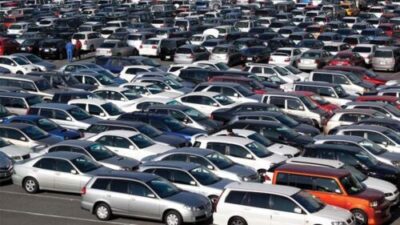
Nigeria spent a record ₦527 billion on passenger cars in Q3 2025, more than doubling last year’s figure.
Consequently, total imports for the first nine months exceeded ₦1 trillion, highlighting strong demand despite higher costs.
Imported Cars Record Q3 Spending
Meanwhile, the weaker naira and exchange-rate liberalisation have pushed up the cost of imported vehicles for Nigerian buyers.
Importers focused heavily on used vehicles, with ₦184 billion worth arriving from the United States alone.
Moreover, Dubai and South Africa continue to supply a significant portion of Nigeria’s passenger cars.
Drivers Of Demand
Analysts argue that currency fluctuations, rather than demand alone, drove the recent rise in import costs.
Despite government efforts to promote local vehicle assembly, Nigeria still relies heavily on imported cars.
Read Also: FCCPC Cracks Down On Rising Southern Flight Fares
Specifically, Q1 2025 imports reached ₦254.6 billion, Q2 stood at ₦224.5 billion, and Q3 surged to ₦527 billion.
Thus, this quarter represents the highest passenger car import value since 2020, showing persistent demand.
Historically, the largest spike occurred in Q2 2023 after the naira sharply depreciated following policy changes.
Even as costs rise, Nigerians continue buying vehicles for both personal and commercial purposes.
Additionally, growth in ride-hailing services, courier businesses, and middle-class households has increased vehicle demand nationwide.
Market Outlook
In dollar terms, Nigeria spent roughly $689 million on passenger cars during the first nine months.
The naira’s weakness further inflates the local cost of imports despite stable global vehicle prices.
Importers particularly target affordable used cars, which dominate the market and attract most buyers.
Furthermore, consumers continue to prefer foreign-made vehicles, limiting the impact of local assembly initiatives.
Rising costs have not slowed purchases among households and commercial fleet operators.
Overall, the import market remains resilient, signalling that Nigeria’s demand for vehicles shows little sign of slowing.