

Just days after one of the most controversial opposition primaries ahead of the 2027 election, former Vice President Atiku Abubakar has taken what may be his most important political step yet — visiting his defeated rival, Rotimi Amaechi.
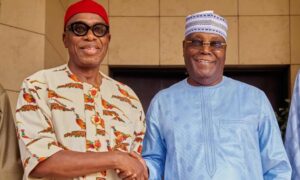
On the surface, it looked like a simple political courtesy.
But inside Nigeria’s tense and fragile opposition landscape, the meeting may carry far deeper meaning.
Because after a bitterly disputed primary, the ADC now faces a dangerous question:
Can the party truly unite behind Atiku before the 2027 battle begins?
The Crisis That Refused To End After The Primary
Atiku emerged as ADC presidential candidate after defeating Amaechi and other contenders in a closely watched contest that attracted national attention.
But instead of ending with celebration, the primary quickly descended into controversy.
Amaechi openly rejected the outcome.
The former Rivers governor accused the process of being riddled with irregularities and questioned the credibility of the exercise before the final declaration was even completed.
That rejection immediately triggered fears of internal division inside the ADC, especially because Amaechi was not just another aspirant.
He was one of the strongest political figures in the race and one of the few candidates capable of mobilising major support structures across different regions.
Why Atiku Cannot Afford To Lose Amaechi
For Atiku, the political mathematics are becoming increasingly clear.
Winning the primary may have secured the ticket.
But winning the election will require something far more difficult, keeping the opposition united.
That reality may explain Thursday’s private meeting.
The former vice president understands that a divided ADC could collapse before the real campaign even begins.
And in Nigerian politics, unresolved primary disputes often become the seeds of future defections, sabotage and silent rebellion.
Atiku appears determined to prevent that scenario before it grows worse.
Amaechi Holds More Power Than Many Realise
Although Amaechi lost the primary, his political influence remains significant.
The former Rivers governor is not merely a former minister or ex-governor.
He is one of Nigeria’s most experienced political strategists, with deep networks across the South-South, northern political circles and parts of the APC establishment he once helped build.
That influence makes his next move critical.
If Amaechi eventually supports Atiku, the ADC could emerge stronger and more competitive nationally.
But if he distances himself from the party or quietly works against the campaign, the ADC may struggle to maintain the image of a united opposition coalition.
Silence Is Fueling More Speculation
Interestingly, neither Atiku nor Amaechi publicly disclosed details of the meeting.
That silence has only intensified speculation.
Some believe the discussion may have involved reconciliation talks and possible power-sharing negotiations ahead of the campaign season.
Others suspect the meeting was simply damage control aimed at preventing a public party crisis.
In Nigerian politics, silence after high-level meetings often speaks louder than press conferences.
And until both men openly clarify their positions, rumours and political calculations will continue dominating conversations.
The Opposition’s Biggest Problem Is Still Unity
The development also exposes a deeper challenge facing opposition politics in Nigeria.
Most opposition alliances collapse not because they lack public support, but because powerful political figures struggle to coexist after internal battles.
Personal ambition, regional interests and control of party structures often destroy coalitions before elections even arrive.
That history explains why the ADC crisis matters beyond one primary election.
If the party cannot manage disagreement internally, critics may question whether it can manage Nigeria itself.
Atiku’s Most Difficult Battle May Be Inside His Party
Ironically, Atiku’s toughest challenge ahead of 2027 may not come from President Bola Tinubu or the APC.
It may come from within his own coalition.
The ADC is rapidly attracting influential politicians from different backgrounds, ideologies and ambitions.
While that growth strengthens the party numerically, it also increases the risk of internal conflict.
Managing those competing interests may ultimately determine whether the ADC becomes a serious national alternative or another opposition experiment that collapses under its own contradictions.
A Political Truce Or Temporary Peace?
For now, the meeting between Atiku and Amaechi may signal an attempt to lower tensions.
But Nigerian politics has repeatedly shown that reconciliation meetings do not always produce lasting peace.
Sometimes they merely postpone future conflict.
Did You Miss? “Tinubu Waited Eight Years” — Cubana Chief Priest Refuses To Quit Politics
The real test will not be the handshake behind closed doors.
It will be whether both men can genuinely work together when the pressure of the 2027 presidential race becomes even more intense.
Because in Nigeria’s opposition politics, unity is often easier to announce than to sustain.