

In a Lagos market buzzing with life, a shopper clutches her purse and sighs — a 50 kg bag of rice now costs almost what she earns in two weeks. Inflation bites deep, and even as the federal government claims victory in bringing down food prices, rice — Nigeria’s beloved staple — still stretches household budgets to the limit.
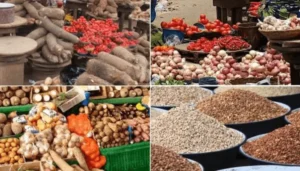
But in the shadows of rice’s rising cost, other staples are quietly taking center stage.
Rice: The Inflation Mirror
Rice has become a national benchmark for food inflation — every price shift in the grain is a pulse check on the economy. Despite government interventions, the cost of production, transport, and insecurity have kept rice relatively expensive.
Farmers lament that input costs — fertilizer, chemicals, labour — remain high even as market prices are forced down.
Yet the hunger doesn’t wait. Families, innovative as ever, are turning to affordable alternatives that tell a story of resilience and adaptation.
1. Garri: The Resilient Cassava Champion
When life gets tough, Nigerians return to garri — the dependable cassava grain that has never failed the table.
Recent government data shows that garri is even being “mopped up into national grain reserves” due to a surplus harvest. This abundance, coupled with local processing, has made it notably cheaper than rice in many markets.
Garri doesn’t just fill stomachs; it sustains a vast value chain — from cassava farmers in Ogun and Oyo to small-scale processors and traders. Its affordability comes with a warning, though:
if government interventions ignore cassava farmers, today’s surplus could turn into tomorrow’s scarcity.
2. Maize: The Grain Of The People
Tuwo, pap, roasted corn — maize feeds Nigeria in countless forms.
Unlike rice, maize is grown locally across all regions, making it less vulnerable to global price shocks. Even with climate challenges and insecurity, its broad cultivation has kept prices lower than rice’s steep trajectory.
Farmers like Timothy Abiola from Ogun State have embraced climate-smart maize farming, reducing losses and turning part of their harvest into animal feed and flour. In inflationary times, maize becomes not just food, but a survival strategy.
3. Beans: Protein Power On A Budget
Though beans prices have climbed, local varieties such as brown beans and honey beans still offer better nutritional value per naira than rice.
For many households, beans are replacing rice as the “main meal” — filling, nutritious, and adaptable. From ewa riro to moin-moin, beans provide both calories and protein at a fraction of the cost of a rice-and-meat meal.
But farmers warn: without subsidies for inputs, Nigeria risks losing its legume advantage. “We can’t sustain low prices if fertilizer costs keep rising,” says a Kwara-based farmer interviewed in the Vanguard survey.
4. Plantain: The Flexible Substitute
Plantain, both ripe and unripe, has become the quiet hero of the Nigerian kitchen.
Fried, boiled, or pounded into amala dodo, plantain offers versatility and satiety. While prices vary seasonally, in many southern markets, plantain meals now cost less than a rice plate.
Its rise shows how food culture evolves under pressure — from side dish to main course, plantain is proof that inflation can spark culinary creativity.
5. Cassava Flour (Eba/Fufu): Local Swallows Rising
Beyond garri, cassava flour has found a new following among budget-conscious homes. Swallows made from lafun or fufu are now replacing rice dishes at mealtime.
The cassava value chain — once viewed as “poor man’s food” — is fast becoming the foundation of food security. With proper processing and packaging, cassava flour products are entering urban supermarkets and export markets alike.
Between Relief and Risk
The federal government celebrates “food price reductions” as evidence that interventions — improved security, farmer training, and subsidised inputs — are working. But voices from the farms tell another story.
Elder David Adeoye, a farmer in Oyo, laments: “We can’t celebrate lower prices when we’re running at a loss. Fertiliser and labour costs keep rising. If this continues, many of us will abandon farming next season.”
This tension — between cheaper food for consumers and survival for farmers — sits at the heart of Nigeria’s food inflation dilemma.
Beyond Price: The Nutrition Equation
Cheap doesn’t always mean healthy. While garri and cassava flour are affordable, they offer mainly carbohydrates.
Also Read: Nigerian Breweries Posts Profits, Dividend Delayed
Rice’s fall from grace opens a wider debate: how can households maintain nutritional balance amid inflation?
Nutritionists warn that an overreliance on low-cost, low-protein foods could worsen malnutrition, especially among children.
Solutions, they say, must pair affordability with awareness — encouraging balanced diets using locally available protein sources like beans, soy, and groundnuts.
A Future Beyond Rice
Perhaps this crisis is an invitation — not just to survive, but to rethink. Nigeria’s dependence on rice, a crop costly to produce and store, has exposed the fragility of its food system.
The future could belong to local heroes — cassava, maize, beans, plantain — each carrying centuries of indigenous knowledge and sustainability potential.
If government policy, farmer support, and consumer awareness align, Nigeria could turn this inflationary storm into a quiet revolution: a return to local resilience.
What’s On Tomorrow’s Plate?
Back at the Lagos market, the shopper finally smiles. Her basket now carries garri, beans, and plantain — the new trio of affordability. It’s not rice, but it’s food. It’s Nigerian.
In the struggle between price and plate, she — and millions like her — are rewriting the story of survival, one meal at a time.