

Doctors in Nigeria are raising urgent alarms as bushmeat consumption climbs in cities, warning that the trend could unleash the next deadly outbreak.
The World Health Organization reports that animals caused three-quarters of new infectious diseases in the past decade.
For example, in 2014, Ebola swept across West Africa after a family in Guinea ate virus-carrying bats, killing more than 11,000 people.
Likewise, some scientists argue that Covid-19 also started with wild animals sold in a market in China.
“This isn’t just a Nigerian problem—it’s a global public-health concern,” stresses vice-president of the Nigerian Medical Association, Ushakuma Anemga.
Appetite Keeps Rising
Meanwhile, demand for bushmeat keeps rising.
A Wildlife Conservation Society survey revealed that more than two-fifths of urban Nigerians ate it in the past year—nearly double the share from 2018.
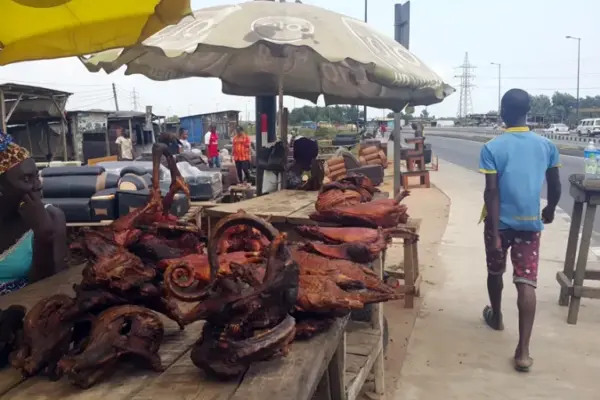
Although the government bans the trade, vendors still sell bushmeat openly in markets, placing it beside chickens and goats.
On a global scale, the World Bank estimates the illegal industry generates up to $10 billion annually, ranking behind only drugs, human trafficking and arms.
At roadside grills and in bustling markets, hunters deliver their hauls, and vendors turn them into skewers of porcupine, antelope or python.
For example, in a stall outside Abuja, Justina Sunday tends her bathtub grill as travellers queue for her peppery skewers.
She insists the meat offers health benefits: “Bushmeat has no fat; it’s natural.
Read Also; Air Peace Adds Fourth Boeing 777 To Drive Global Growth
Our ancestors ate it and lived long lives.”
Health Risks Multiply
Yet health experts counter her claims.
They argue that unsafe practices—such as open-air butchering, a lack of veterinary checks and the absence of protective gear—create “silent pathways” for new infections.
“Nigeria has made progress in outbreak response,” notes Nusirat Elelu, a zoonotic-disease researcher at the University of Ilorin.
“However, our surveillance systems still can’t reliably detect illnesses linked to bushmeat.
We are sitting on a ticking time bomb if this trade continues unregulated.”
Wildlife Under Siege
At the same time, conservationists warn that the appetite for bushmeat devastates Nigeria’s wildlife. Hunters kill everything they find—from pregnant females and juveniles to endangered species—because buyers pay high prices.
In some cases, rare animals fetch more than one million naira (£520), fuelling reckless hunting.
Although Nigerian law prohibits the killing of protected animals, traders disguise their meat and trick inspectors, while poorly trained law enforcement officers fail to recognise the difference.
“Without proper training and tools, enforcement becomes meaningless,” argues, a biodiversity professor at the University of Uyo, Edem Eniang.
Despite these risks, hunters rely on bushmeat for survival.
“I have sold to everyone—even police and customs officers,” says, a southern hunter, Oladosu Adelana.
“They talk about the laws, but they are also my customers.”
Ultimately, Nigeria faces a stark choice: strengthen regulation to protect both people and wildlife—or allow demand for bushmeat to set the stage for another devastating outbreak.