

In Nigeria’s political jungle, loyalty is rarely eternal; it’s rented, borrowed, and traded like commodities on the open market. Governors, the so-called “emperors of their states,” are often the most daring players when the game of defection begins.
With 2027 lurking just beyond the horizon, the whispers in political corridors are getting louder: some governors are already positioning themselves for a grand switch.
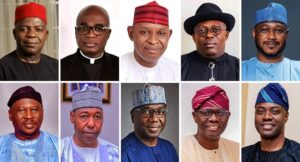
The truth? Nigerian politics has never been about ideology—it’s about survival, negotiation, and power consolidation. One minute, a governor swears undying loyalty to a party that “birthed his political destiny.” The next, he’s dining with rivals, plotting how to reinvent himself as a national kingmaker.
And as we inch closer to the high-stakes 2027 campaigns, the stage is being set for the most dramatic defections since 2015. Why? Because the stakes are higher than ever.
Inflation is choking homes, insecurity has turned neighborhoods into battlefields, and Nigerians are asking tough questions about the ruling class.
Governors, sensing the mood of the people, know that clinging to a sinking ship could cost them political relevance. On the other hand, jumping ship at the right time could catapult them into national prominence.
This is not about random gossip—it’s about patterns. History shows us that Nigerian governors are some of the boldest defectors: remember 2014, when the PDP lost five powerful governors to the APC in one sweep? That singular earthquake shifted the balance of power and set the stage for Buhari’s 2015 victory.
In 2027, we may be heading for a sequel—one possibly even more chaotic.
So the question is not if defections will happen. The real question is who will move first, who will follow, and what these moves mean for Nigeria’s fragile democracy.
Here are five governors who, based on political realities, alliances, and body language, may defect before the campaigns of 2027 officially begin.
1. Governor Seyi Makinde (Oyo State – PDP)
Makinde has perfected the art of sitting on the fence without getting dirty. Though technically PDP, his body language during the 2023 elections leaned heavily towards Tinubu and the APC bloc.
He survived politically by playing both sides, but his romance with the G-5 governors and his refusal to openly back Atiku showed where his heart lies.
As 2027 looms, Makinde could fully embrace APC—or a rebranded “mega party”—to secure national relevance beyond Oyo. After all, in Nigerian politics, betrayal is just strategy with a new suit.
2. Governor Sim Fubara (Rivers State – PDP)
Rivers politics is Nigeria’s own version of a Nollywood thriller: suspense, betrayal, and daily plot twists. Fubara’s feud with Nyesom Wike, his political godfather turned enemy, has already pushed him into a survivalist mode.
With PDP split down the middle and Wike pulling strings within Tinubu’s APC, Fubara may have no choice but to defect—either to strengthen his own camp or to escape being politically strangled. His next move could shape the balance of power in the entire South-South.
3. Governor Bala Mohammed (Bauchi State – PDP)
Bala Mohammed has always been an ambitious player with eyes beyond Bauchi. In 2023, he flirted with the idea of running for president before “stepping down” for Atiku.
But insiders know Bala is not the type to keep playing second fiddle. If he senses PDP’s national structure collapsing—or if Atiku decides to give it one last shot—Bala could flip to APC or join forces with another rising bloc.
His defection would be less about loyalty and more about personal positioning for 2027 or beyond.
4. Governor Alex Otti (Abia State – Labour Party)
Otti’s victory in 2023 was a breakthrough for the Labour Party, but the honeymoon may not last. LP is still struggling with internal cohesion, structure, and grassroots penetration outside urban centers.
Also Read: Rivers State: Things To Expect As Fubara Resumes Office
For a governor who wants to consolidate power, Otti might see a switch to PDP or APC as a smarter bet before 2027. Especially if Peter Obi’s movement loses steam nationally, Otti may not want to carry a fragile party into the storms of 2027. In Nigerian politics, pragmatism often trumps sentiment.
5. Governor Umar Bago (Niger State – APC)
Now, this may shock many. But even within APC, cracks are beginning to show. Umar Bago of Niger has been quietly building his own political empire, and his frustration with Tinubu’s handling of the economy is no secret in northern circles.
If APC fails to stabilise Nigeria’s economy before 2027, Bago could become one of the northern governors to defect—either to PDP or a new coalition seeking to wrestle power from Tinubu’s grip. Remember, the North has always played the numbers game, and Bago knows this well.
All Road Leads To 2027
The coming months will be drenched in political drama. Governors will smile in the daytime with their parties but hold secret night meetings with rivals. Defection, in Nigeria, is not betrayal—it’s self-preservation.
And as 2027 approaches, the defections of these governors (and possibly more) will reshape alliances, redraw battle lines, and decide whether Tinubu survives politically or whether a new force emerges.
The lesson? Nigerians must pay attention—not just to Abuja’s noise, but to what’s happening in the states. Because once governors start defecting, the entire national map can change overnight.